Home / Guides / What happens if your carry-on is too big
Guide
What happens if your carry-on is too big
Limits change; confirm with your airline before you fly. Every figure here links to the airline page it came from.
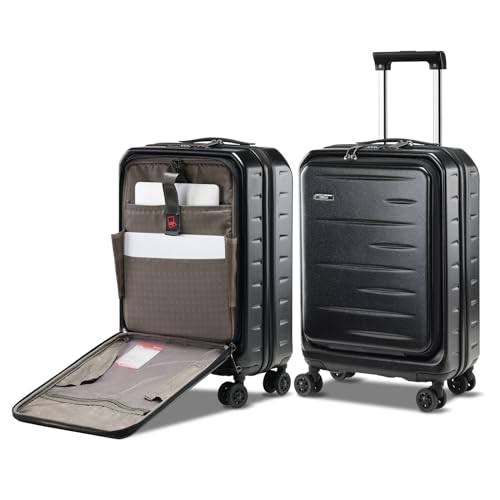
CENSIEN 20 Inch Carry On Luggage 22×14×9 Airline Approved with Front Pocket
21.46 x 13.78 x 8.66 in, wheels and handles included; 6.5 lb listed
Listed at 21.46 x 13.78 x 8.66 inches with wheels included, this bag clears the common 22 x 14 x 9 inch carry-on limit with margin on every side, which is the simplest way to avoid a gate-check conversation altogether.
$74.99 Check price on Amazon
Prices change often.
What actually happens at the gate if a carry-on does not fit?
A gate agent or check-in staff member measures the bag against the airline's sizer box, and if it does not slide in without being forced, the bag gets tagged and sent to the belly of the plane instead of the overhead bin. This can happen at check-in, at the gate before boarding, or even at the door of the plane if the overhead bins fill up before every bag is stowed. Either way, the bag is no longer in the cabin, so anything needed during the flight should come out of it first.
Does gate-checking a carry-on always cost money?
It depends on the airline, and this file does not contain a published fee schedule for gate-checking an oversized carry-on specifically. What airlines do publish clearly are fees for an overweight or oversize checked bag, which is a related but different situation. American Airlines states that bags over 115 inches total (length plus width plus height) or over 100 lb are not accepted at all, gate-check or otherwise. Southwest and JetBlue both state that an oversize bag, 63 to 80 inches total, is accepted for a fee, though neither publishes a single fixed number for that fee on the page this site draws from.
| Airline | What its published page says about an oversized bag |
|---|---|
| American Airlines | Bags over 115 in / 292 cm total, or over 100 lb, are not accepted at all |
| Southwest | Oversize bags from 63 to 80 in total are accepted for a fee |
| JetBlue | Oversize bags from 63 to 80 in total carry a fee, alongside its separate overweight fee for 51 to 99 lb |
| Frontier | Bags over 100 lb or 110 linear inches are not accepted at all, checked or otherwise |
What if the bag is only slightly over the limit?
A sizer box does not compress, so a bag that is a quarter inch over can be pulled just as easily as one that is 3 inches over. Whether that actually happens on any given flight depends on how strictly staff are checking that day and how full the overhead bins already are, none of which is something this guide can predict from a published baggage page. Do not count on being close enough.
Can an oversized carry-on just be checked at the counter instead?
Yes, and doing it before arriving at the gate is usually cheaper and less stressful than being pulled aside during boarding. Frontier states that bags over 100 lb or 110 linear inches are not accepted at all, checked or otherwise, so an oversized bag needs to be within that ceiling even to be checked. Most airlines will check an oversized carry-on for the same fee structure as any other oversize or overweight checked bag, once it is within what the airline accepts at all.
Does a too-big carry-on ever fly for free?
Sometimes, informally, on a flight with plenty of open overhead space or when staff decide it is not worth the argument. This is not something any airline publishes as a policy, and it is not something to plan around. Treat every oversized bag as a bag that will get flagged, and be pleasantly surprised on the days it is not.
How to avoid the situation entirely
Measure the bag with wheels and handle attached and compare it, sorted largest to smallest, against the specific airline's published limit before packing for the trip, not after arriving at the airport. A bag built to the common 22 x 14 x 9 inch figure clears most US and Canadian carriers with room to spare, and this site's fit calculator checks a bag's own dimensions against every airline in this guide's data at once.
Gear for this
 $48.00Check price
 $77.16Check price
 $131.99Check price
 $413.99Check price
Frequently asked questions
Will I always be charged a fee if my carry-on gets gate-checked?
Not always, but plan as if it will happen. This file shows that some airlines, like American Airlines, refuse an oversized bag outright past a certain size rather than charging for it, while others, like Southwest and JetBlue, explicitly charge for an oversize bag. Neither publishes a single universal number for a routine gate-check of a slightly oversized carry-on, so check the specific airline before flying.
Is a gate-check fee the same thing as an overweight checked bag fee?
No, they are related but separate charges. An overweight fee applies to a bag's weight once it is already being checked, and several airlines publish clear dollar amounts for that. A gate-check situation happens because a carry-on did not fit in the cabin, and whether that specific event carries its own fee, beyond any oversize or overweight charge that applies once the bag is checked, is not something every airline publishes clearly.
What happens if my bag is both oversized and overweight?
Both problems apply at once, and some airlines set a hard ceiling past which the bag will not be accepted in any form. American Airlines will not take a bag over 115 inches total or 100 lb, and Frontier will not take one over 110 linear inches or 100 lb. Below those ceilings, expect both an oversize charge and an overweight charge to apply separately, if the airline publishes both.
Can I just take things out of my bag at the gate to make it fit?
Sometimes, if there is room to redistribute items into a personal item or another bag, but this only helps with weight, not with the bag's own rigid outside dimensions. A bag that is structurally too big for the sizer will not shrink by removing contents, so the fix has to happen before arriving at the gate, not during boarding.
Researched, not professional advice. Airline rules change; confirm with your airline before you fly.